
Kitchen Remodel Cost in Los Angeles — 2026 Guide
Most kitchen remodels across the Los Angeles market cost $45,000 to $120,000 in 2026, with the midpoint around $75,000 — that is a market range, not our own book. Our 27 completed kitchens ran $23k–$84k, median $50k. Which end of that range a particular kitchen lands on is decided by three things, and almost never by the cabinet brand or the countertop slab: the size of the room, whether the layout moves, and the level of finish. Those three are why a number this wide is the only honest answer to give a stranger — and why Design Onn Point will narrow it to a real figure for your kitchen from a photo and your ZIP code, free, within one business day. Here's what actually drives the number, with real ranges Design Onn Point has built to, across 12+ years in business remodeling 1,200+ LA homes.
Final costs from our own completed Los Angeles projects, not estimates · Licensed design-build, CSLB #1133368 · 5.0★ on Google · See all 73 project prices
LA kitchen remodel cost tiers (2026)
The 2026 LA kitchen market is bimodal: the low end lives around $25k for cosmetic refreshes, the top end pushes past $160k for full custom rebuilds with structural work. Most of our clients land in the middle — an $85k tier that buys real design freedom without waterfall-marble tax. The tier table below is the range we quote to across finished LA projects; per-project timelines assume no hillside / HPOZ / coastal review adder.
Los Angeles market figures — not a summary of our own completed projects.
| Tier | Typical scope | LA cost range (2026) | Timeline |
|---|---|---|---|
| Cosmetic refresh | Cabinet doors, counters, appliances swap; keep layout + plumbing | $25,000–$45,000 | 3–5 weeks |
| Standard remodel | New cabinets, counters, appliances, lighting, light electrical | $45,000–$85,000 | 6–9 weeks |
| Mid-tier reconfigure | New layout + island, soft-close semi-custom, quartz waterfall | $85,000–$120,000 | 9–12 weeks |
| Full custom + structural | Wall removal + steel beam, custom cabinets ceiling-height, natural stone, paneled appliances | $120,000–$180,000+ | 12–16 weeks |
What 27 completed kitchens actually cost
Set against the market tiers above, here is our own record. Across 27 kitchens we have finished and closed out, final costs ran $23k–$84k, with a median of $50k. Final contract values, not estimates.
We publish no cost per square foot, and that is deliberate. Our archive records a job number and a final price. It does not record finished square footage, so a per-foot rate could only be reverse-engineered from an assumed room size — a guess wearing the costume of data. You will see the format everywhere; treat any per-foot figure you are given as a starting assumption rather than a measurement.
The tier table above describes the wider Los Angeles market, which reaches higher than our own book does. Both are useful: one tells you what the city charges, the other tells you what we have actually delivered.
| Where our kitchens landed | How many | Share of the set | Range inside the band |
|---|---|---|---|
| Under $40k | 5 of 27 | 19% | $23k – $38k |
| $40k – $60k | 11 of 27 | 41% | $40k – $59k |
| $60k – $80k | 10 of 27 | 37% | $60k – $76k |
| Over $80k | 1 of 27 | 4% | $84k – $84k |
Real projects. Real prices.
73 finished remodels published with their final price — nothing hidden.
What 27 finished LA kitchens actually cost: a median of $50k, in a range of $23k–$84k. Real final prices from our own job records, not estimates.
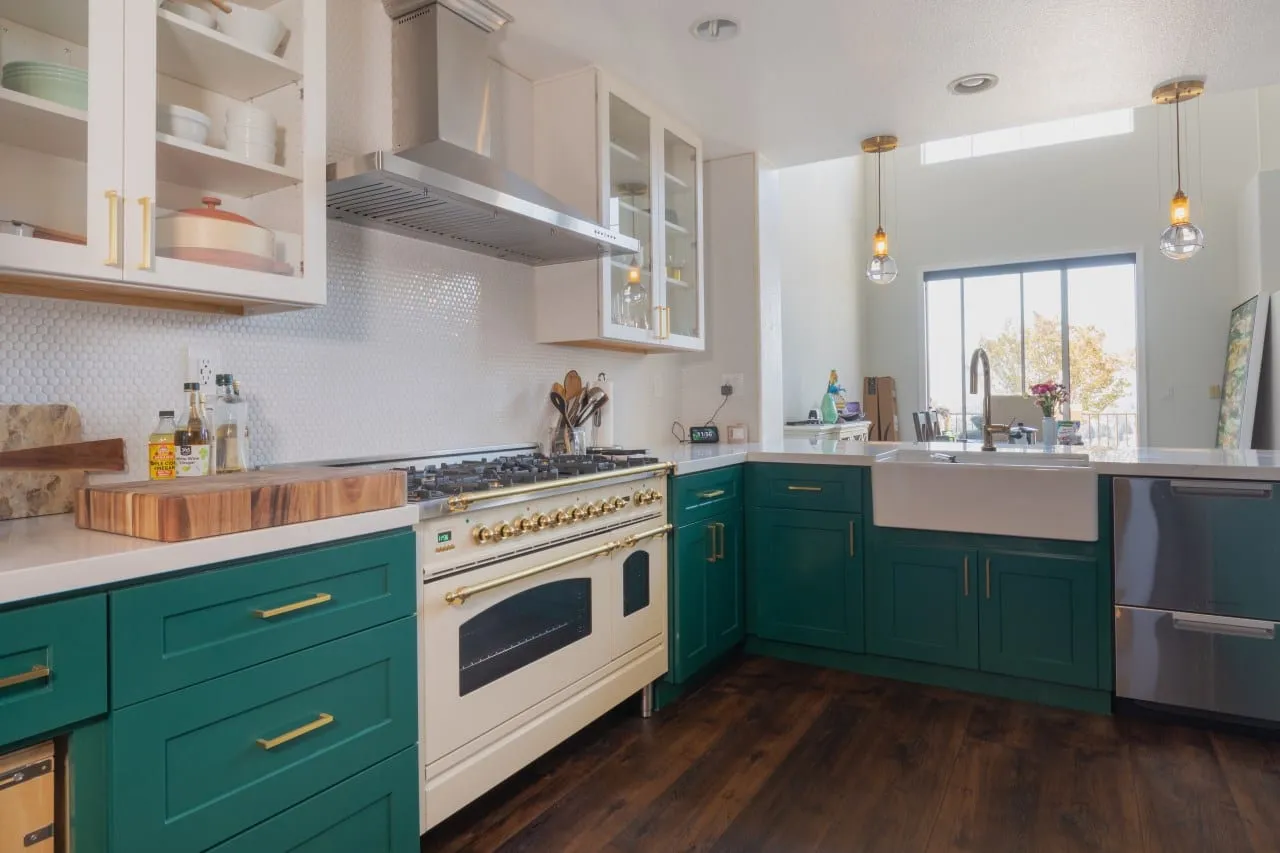 $38,000
 Emerald shaker cabinetry and brass hardware around a cream range and an apron sink.
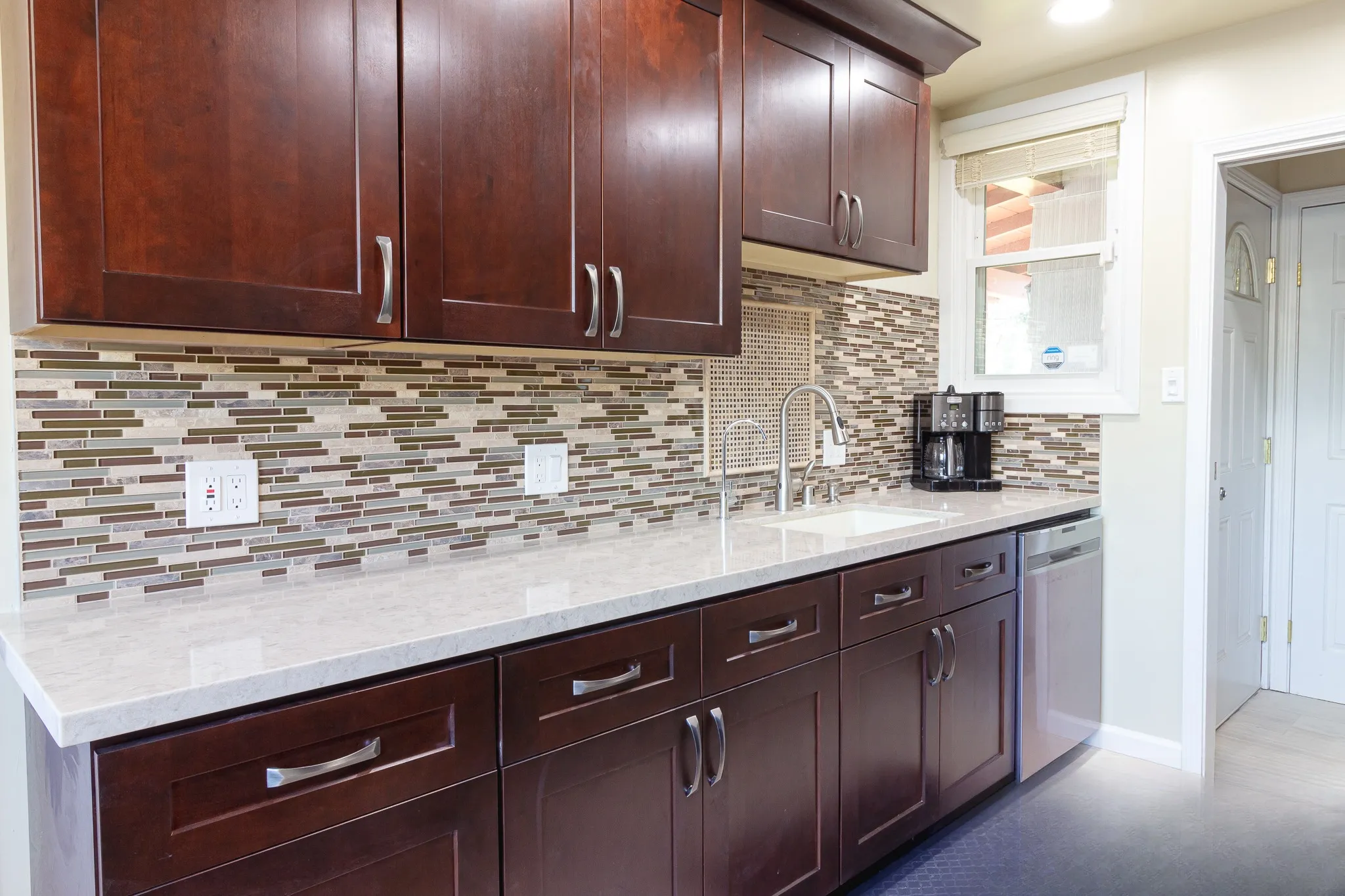 $41,000
 Espresso shaker cabinetry, light quartz counters and a linear glass mosaic backsplash.
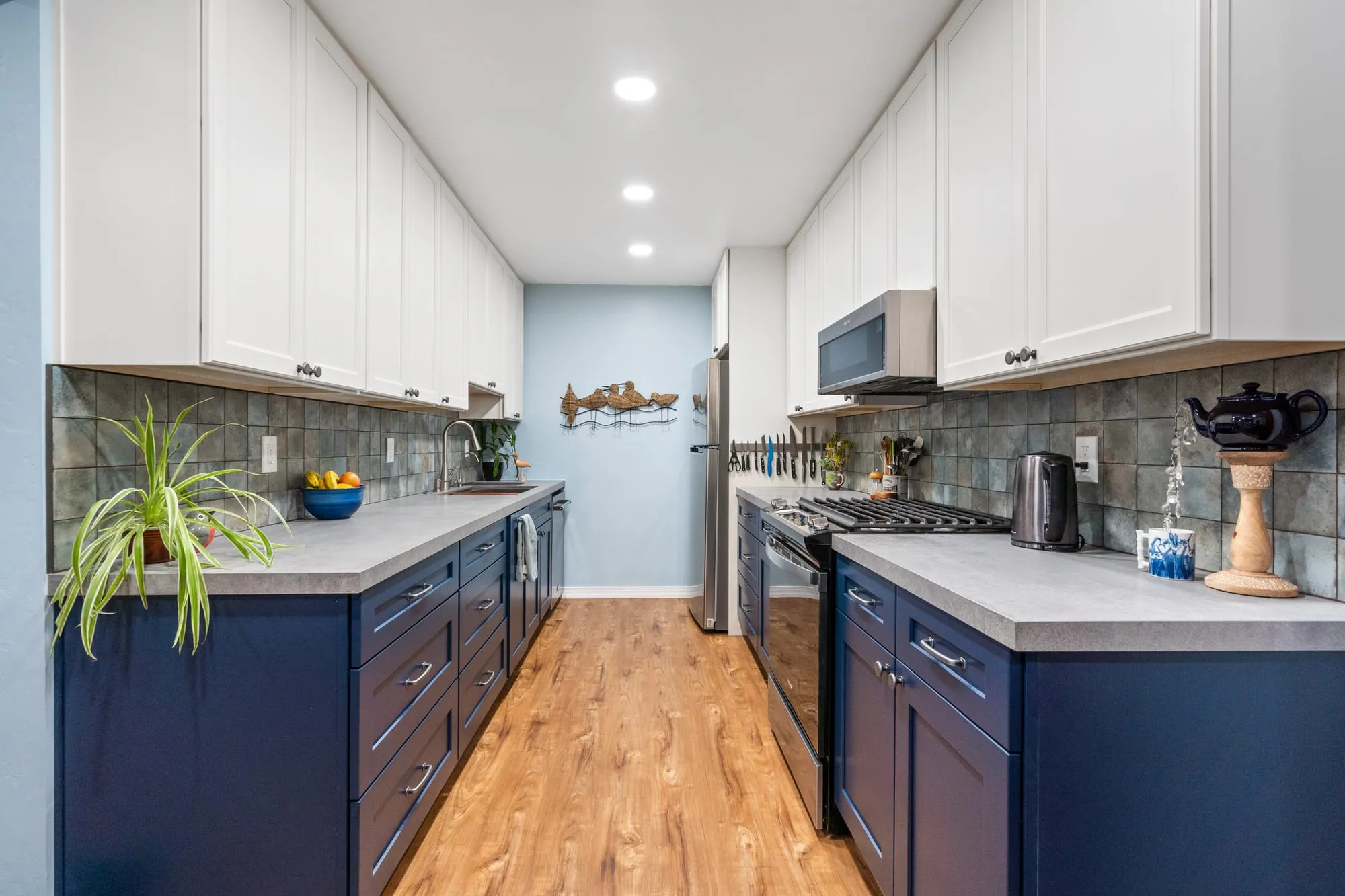 $50,000
 Navy shaker lowers under white uppers, with a slate-tone tile backsplash and a wood ledge shelf.
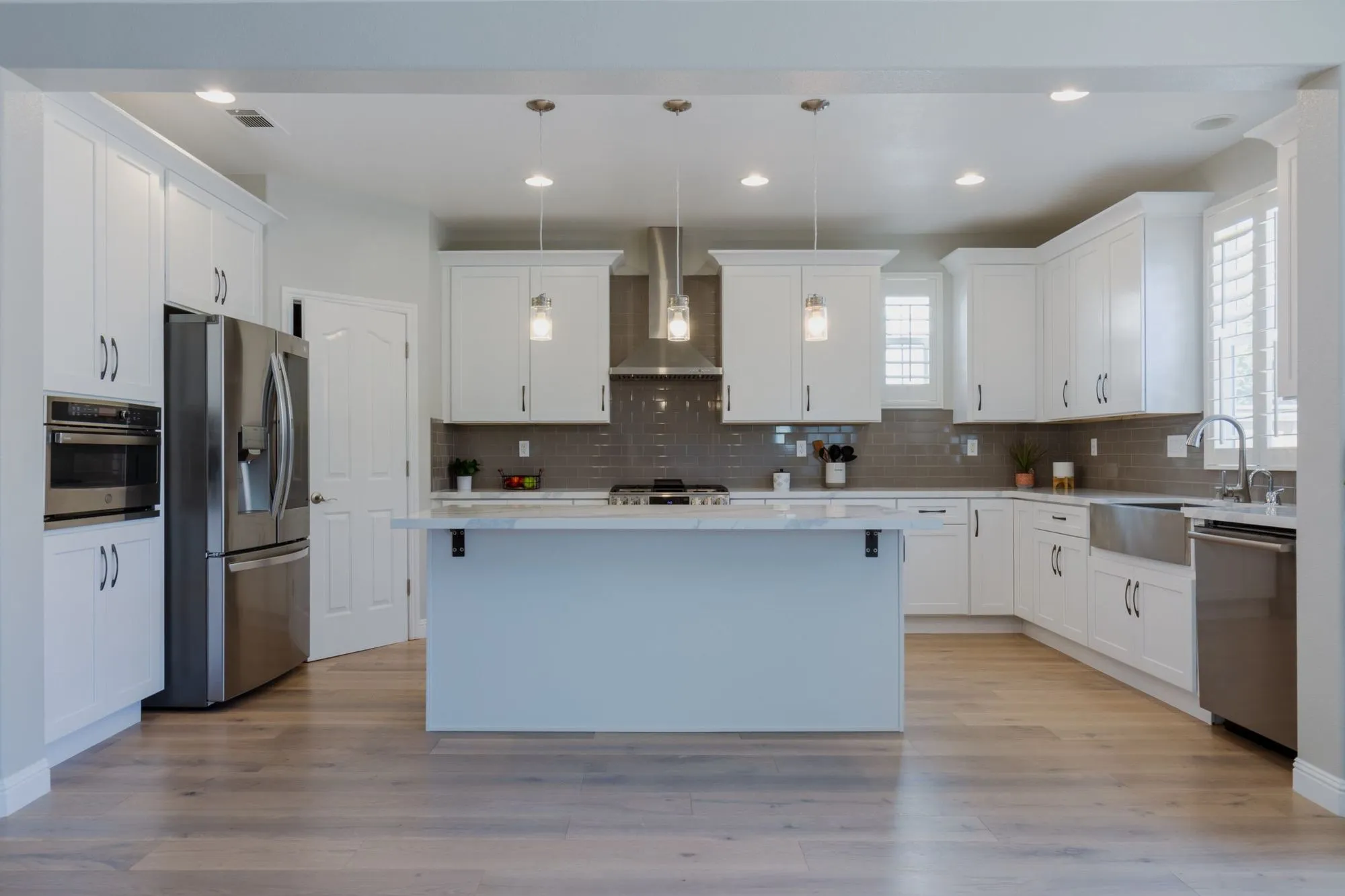 $72,000
 Honey-oak cabinetry replaced with white shaker fronts and a marble-look quartz island.
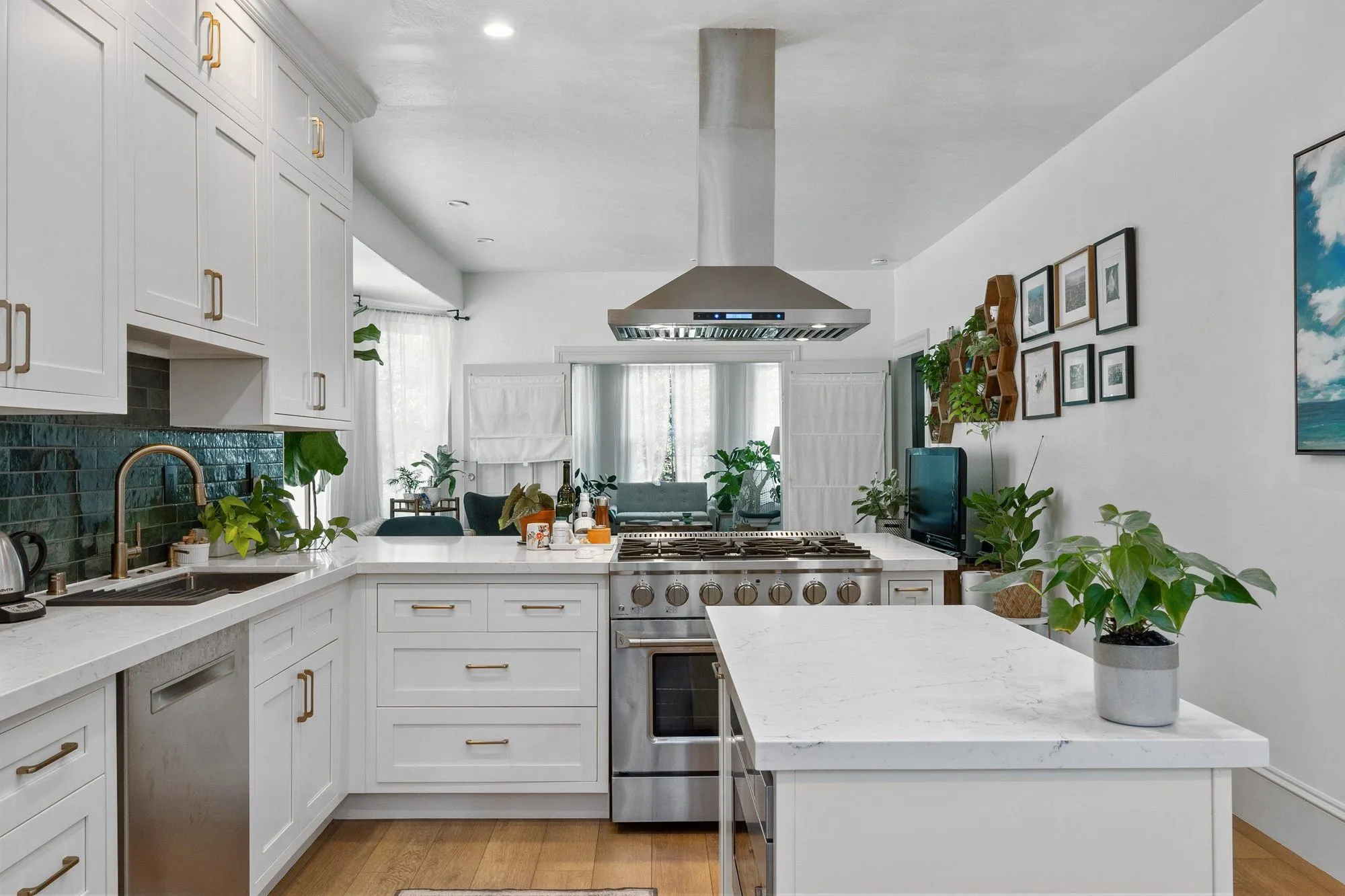 $72,000
 White shaker cabinetry against a deep teal backsplash, with an island under a stainless hood.
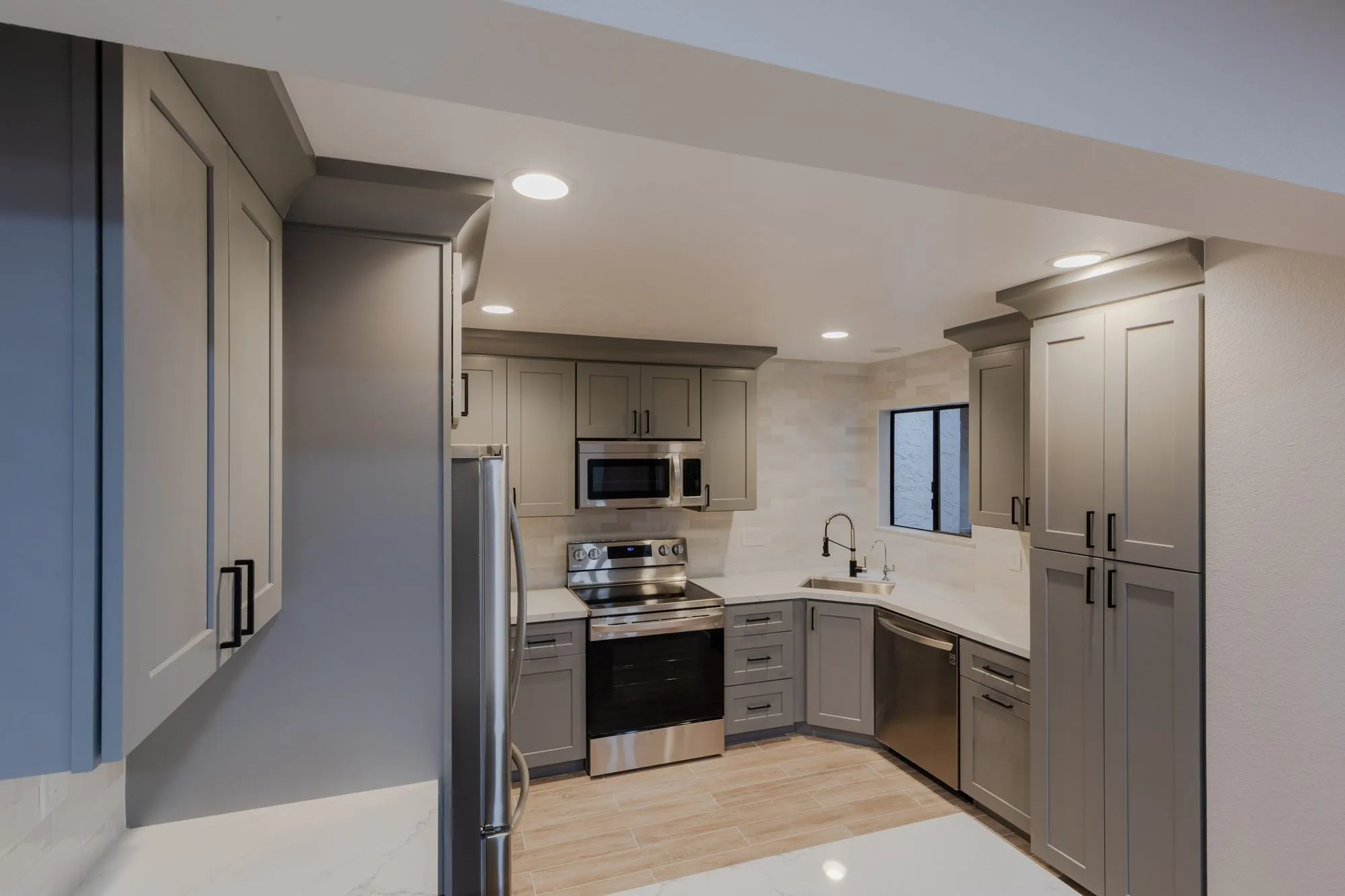 $84,000
 Warm grey shaker cabinetry with quartz counters, plus floating vanities in dark stone tile.
Line-item budget breakdown ($85k typical LA kitchen)
Homeowners assume cabinets are the biggest cost. They're usually the second-biggest — labor + installation is the top line item on almost every project we finish. The split below is a Los Angeles market breakdown, not our own project data — we publish final project totals, not a line-item breakdown of each job. Use it to sanity-check a quote rather than as a price. Apply the percentages to whichever band from our completed-project table above matches your project.
Los Angeles market figures — not a summary of our own completed projects.
| Line item | Typical dollar amount | % of $85k project |
|---|---|---|
| Cabinets (semi-custom) | $20,000 | 24% |
| Labor + installation | $24,000 | 28% |
| Countertops + backsplash | $10,500 | 12% |
| Appliances | $9,000 | 11% |
| Plumbing + electrical | $7,500 | 9% |
| Flooring | $4,500 | 5% |
| Lighting + fixtures | $3,500 | 4% |
| Permits + design + project management | $6,000 | 7% |
LADBS kitchen permits: what you actually pay
Any LA City kitchen remodel that moves plumbing, adds gas, adds circuits, opens a wall, or changes HVAC needs an LADBS permit. Cosmetic-only work (paint, cabinet doors, like-for-like fixture swaps) doesn't. Permit fees are calculated off project valuation, plus per-discipline fees for electrical/plumbing/mechanical. For most $75k–$120k LA kitchens, expect $1,500–$3,500 in LADBS fees total, with plan-check adding 3–6 weeks to your calendar.
Add-ons that push permit costs and timeline higher:
• Expedited plan check: doubles the base fee but shaves 1–3 weeks off review
• Hillside review: adds soils / geotechnical report ($3k–$6k) if the lot slopes >4:1
• HPOZ (Historic Preservation Overlay Zone): adds 4–8 weeks + board sign-off for street-visible changes; interior-only kitchen work usually escapes review
• Coastal zone (west of Lincoln in parts of Venice, Palisades, Marina del Rey): adds California Coastal Commission review + 4–12 weeks
• Very-High Fire Hazard Severity Zone (hills, Bel Air, Palisades): triggers Chapter 7A materials review — usually minor kitchen impact but real on scope with new windows
Los Angeles market figures — not a summary of our own completed projects.
| Permit path | LADBS fee range | Timeline (2026) |
|---|---|---|
| Standard plan-check kitchen | $1,500–$2,800 | 4–6 weeks |
| Expedited plan-check | $3,000–$5,500 | 1–3 weeks |
| Hillside + geotech | $4,500–$9,000 | 8–12 weeks |
| HPOZ street-visible | $2,500–$4,500 + board fees | 8–14 weeks |
| Coastal Commission review | $4,000–$7,500 | 10–18 weeks |
Kitchen energy compliance: what actually costs
The state energy code applies to kitchen remodels when you touch electrical (JA8 high-efficacy lighting requirements), gas (any new gas run triggers combustion-air documentation), or ventilation (range hood CFM requirements based on cooktop type). Most of what energy compliance costs on a kitchen remodel is minor — LED recessed cans replacing incandescent, a properly-sized vented hood — but two specific triggers push cost meaningfully:
Gas-to-induction conversion (increasingly common in 2026): if your existing panel doesn't have a spare 40A double-pole slot for the induction cooktop, the electrician's cost climbs from ~$800 for the circuit run to $3,500–$6,000 if the panel needs an upgrade to accommodate the new load. The energy code doesn't require the conversion; California's building-electrification incentives (LADWP + statewide rebates) subsidize it heavily enough that many owners do it anyway.
Range hood CFM sizing: the energy code requires vented range hoods sized to at least 100 CFM continuous or 300 CFM intermittent for most residential cooktops. A 42-inch chimney hood with proper external venting through the roof or an exterior wall adds $1,200–$3,500 vs. the code-minimum ductless recirculating hood many older kitchens have. Our default spec includes external ducting on every remodel.
JA8 lighting: all screw-in and pin-based lighting fixtures installed in a permitted kitchen remodel must be JA8-certified (California-standard high-efficacy LED). This is a $0 cost delta today vs. incandescent — every mainstream fixture is JA8-compliant — but it's a spec item to confirm with your electrician.
Local overlays: Beverly Hills, Santa Monica, Culver City, WeHo differences
LADBS is the default for City of LA properties, but LA County has 88 incorporated cities, and several — Beverly Hills, Santa Monica, Culver City, West Hollywood, Malibu, Manhattan Beach — run their own building departments with their own quirks. If your address isn't strictly City of LA, verify which department has jurisdiction before quote:
| Jurisdiction | Plan-check window (2026) | Notable adders vs. LADBS |
|---|---|---|
| City of LA (LADBS) | 4–6 weeks standard | Baseline for cost/timeline comparisons |
| Beverly Hills | 3–5 weeks (often faster than LADBS) | Historic-property review adds 6–12 weeks on Sunset-adjacent + estate-scale properties |
| Santa Monica | 4–8 weeks | Coastal Zone review (west of Lincoln) adds 6–12 weeks for anything beyond like-for-like |
| Culver City | 4–7 weeks | Green-building ordinance adds specific insulation + fixture specs |
| West Hollywood | 4–7 weeks | Design-review board can weigh in on street-facing exterior changes even for interior remodels with window swaps |
| Malibu | 8–16 weeks | Coastal + hillside almost always triggered; fire zone Chapter 7A mandatory |
The surprise line items most quotes leave out
Three categories of cost homeowners get blindsided by on their first LA kitchen quote:
1. Old-house systems. LA's 1920s–1960s housing stock hides knob-and-tube wiring, galvanized supply plumbing, cast-iron drain stacks past end-of-life, and non-code framing from prior unpermitted work. Our finished-project reserve for discovered conditions on pre-1970s stock is $5,000–$12,000. Honest quotes carry a documented reserve line; lowball bids that don't are converting future change orders under duress pricing.
2. Disposal + dust protection. Demo on a full kitchen produces 3,000–5,000 lbs of debris. LA County tipping fees + dumpster rental run $1,200–$2,500 per project. Plastic zip-wall dust barriers + HEPA air scrubbers keeping the rest of the house livable during construction: $800–$1,500 more. These are real costs that get hidden in "labor" on cheap bids.
3. Punch-list + warranty work. Most contractors quote you the cost of building the kitchen. They don't quote you the cost of coming back to adjust a cabinet door, swap a defective fixture, or fix a drawer slide that surfaced 90 days after completion. Budget $1,500–$2,500 for post-completion items — or pick a builder who includes them in the quote (see our published warranty terms).
Los Angeles market figures — not a summary of our own completed projects.
What each tier actually buys, finished project
$45k tier — cosmetic refresh: stock or semi-custom cabinets, quartz counters (mid-grade), 4-piece appliance package ($3k–$5k), tile backsplash, LED recessed + 1 pendant fixture, light electrical work only. No layout changes. Assumes existing plumbing + electrical panel can handle the new loads. 3–5 week schedule.
$85k tier — the LA sweet spot: semi-custom cabinets with soft-close + interior accessories, premium quartz or entry quartzite counters, 5-piece appliance package ($6k–$10k), full-height backsplash, layered lighting plan (recessed + pendants + under-cabinet + toe-kick), new plumbing fixtures, possibly an island addition or peninsula. Panel upgrade if needed. 6–9 week schedule.
$120k tier — reconfigure + soft structural: all of the $85k tier + wall removal (with structural engineer sign-off + steel beam if load-bearing), custom cabinets ceiling-height, natural stone counters + waterfall island, paneled or premium appliances, statement lighting, integrated dining nook or hidden butler's pantry. 9–12 week schedule.
$180k+ tier — full custom + heavy structural: all of $120k tier + extensive structural reconfiguration, Wolf / Sub-Zero / Miele appliance package, book-matched natural stone, custom millwork throughout, integrated smart-home lighting + HVAC controls, new HVAC + dedicated electrical panel, sometimes bump-out addition. 12–16+ week schedule.
Los Angeles market figures — not a summary of our own completed projects.
Kitchen remodel ROI in LA (2026)
Zonda's 2025 Cost vs. Value Report — the 2025 edition, its 38th annual — is the standard national benchmark for remodel ROI. It puts a midrange minor kitchen remodel at 112.9% of cost recouped nationally: an average job cost of $28,458 returning $32,141 in resale value. That is one of very few remodeling projects that returns more than it costs.
The useful comparison is not national against LA, it is minor against major. Cosmetic and layout-preserving work recoups near or above its cost; a full gut with structural change recoups a far smaller share, because much of the money goes into things a buyer never sees. That is an argument for right-sizing the scope, which is the same advice the rest of this page gives.
We do not publish an LA-metro figure from the report. The metro tables sit behind the publisher's paywall and we are not going to approximate a number and present it as sourced.
The bands below are a trade estimate of how Los Angeles resale tends to behave by scope. They are not from the Cost vs. Value Report, and they are not a summary of our own completed projects — we publish those as final prices, not as recovery percentages. Treat them as a shape, not a figure:
Los Angeles market figures — not a summary of our own completed projects.
| Project type | LA market ROI (typical) | Notes |
|---|---|---|
| Cosmetic refresh ($25k–$45k) | 95–110% | Fastest payback; often exceeds cost on listing turnaround if the old kitchen was a clear objection |
| Standard remodel ($45k–$85k) | 80–95% | The sweet spot for resale-motivated remodels |
| Mid-tier reconfigure ($85k–$120k) | 75–90% | Structural improvements (open-plan) command a premium in LA listings |
| Luxury / custom ($120k+) | 55–75% | ROI drops but lived-experience jumps; typically justified by 5+ year hold |
Common mistakes we're called to remediate on other contractors' LA kitchens
The finished projects we're asked to REMEDIATE from other contractors' work in LA tell the same story every quarter. If you're evaluating bids from firms other than DOP, watch specifically for these five patterns — each one shows up in our remediation queue 4-6 times a year:
1. Missing or fake waterproofing under stone counters. Marble, quartzite, and porous quartz counters over an island with a cutout for the sink NEED a proper undermount sealant + adhesive spec + moisture barrier around the sink opening. The cheap installs skip the barrier; water gets under the stone; the substrate rots; the counter cracks 2-4 years later. We remediate these by pulling the counter entirely — costs the client 60-80% of a fresh install.
2. Undersized electrical panel + no proper grounding. LA houses built pre-1990 often have 60-100 amp panels. Modern kitchens with induction cooktops, wall ovens, dishwashers, disposals, microwaves + coffee stations pull 40-60 amps just for the kitchen. Bidders who don't spec a panel upgrade save $3-5k upfront and hand you a kitchen where the main breaker trips daily. Real fix requires panel replacement — $3.5-6k retrofit.
3. Improper structural work on wall removal. Load-bearing walls need engineered steel or LVL beams with proper foundation-to-roof load transfer. Cheap installs use dimensional lumber "we've always used this size," get a friendly inspector to sign off, and hand you a house where the ceiling sags 1-2 inches within 3 years as the beam creeps. Retrofit means opening the wall AGAIN + engineering a proper beam. $8-15k remediation.
4. Range hood ducted to nowhere. the energy code requires venting to the exterior. Cheap installs cut the duct into the ceiling cavity or run it to a soffit that goes nowhere, capturing steam + grease inside the ceiling drywall. Mold + smell issues 6-12 months later. Retrofit means opening the ceiling + running proper external ductwork. $2-4k.
5. Cabinets over uneven floors. Cabinets require level installation surfaces or the doors + drawers misalign progressively. Cheap installs shim aggressively at install time; over 1-2 years the shims settle and the doors drift out of true. Onn's standard: level the floor with self-leveling compound BEFORE cabinet install adds $800-1500 and prevents the drift.
Every remediation in that list is expensive because it requires undoing finished work to fix the underlying problem. Choosing a contractor who does these right on the first install saves 3-8x the cost delta on the front end.
LA kitchen remodel financing options (2026)
Cash + HELOC dominate our client mix on kitchens under $85k. Above that, construction loans and cash-out refi enter the picture, plus contractor-partnered platforms for clients whose home equity or credit position doesn't support a standard HELOC. The trade-off matrix as of 2026:
Los Angeles market figures — not a summary of our own completed projects.
| Financing type | Typical rate (2026) | Best for | Watch out for |
|---|---|---|---|
| Cash (savings) | N/A | Any project size | Zero interest but opportunity cost — HELOC often smarter if invested cash beats the rate |
| HELOC (home equity line) | 8–10% variable | Kitchens $30k–$120k | Variable rate; requires ~20%+ equity + strong credit score |
| Construction loan | 9–12% fixed portion | Large or scope-creep projects | Complex draw schedules; typically requires GC that has done construction-loan draws before |
| Cash-out refi | 7–9% | Only if existing mortgage rate is already high | Almost never worth it in 2026 if existing rate is 5% or lower |
| Contractor-partner platform (Enhancify) | 12–18% depending on credit | Clients without HELOC-eligible equity or strong credit | Higher rates; we surface it as an option, not our recommendation |
How to get an accurate quote (not a sales pitch)
A real quote needs four things from you: (1) a measured floorplan with the existing layout, (2) photos of the current kitchen — all four walls + ceiling + inside the panel + inside the sink cabinet, (3) a rough scope list (replace cabinets? move sink? open up to dining?), (4) a budget range you'd consider — not so the contractor quotes to your budget, but so they can tell you honestly what's achievable for it.
If a contractor quotes your kitchen sight-unseen with a single number, that number will move once the walls open. Design Onn Point does a free in-home consult before any real quote, because the unseen conditions (electrical, plumbing, structural, finish-level you actually want) drive the price more than the visible scope. Our finished-project estimator below gives a ballpark you can budget-check against; the real number requires the site visit.
A quick note on the estimator: the ranges are pulled from actual finished LA kitchen projects across 12+ years in business. They assume no hillside, coastal, HPOZ, or fire-zone overlays on the property. If any of those apply to your address, add 8-18% to the calculator's output as a working number. If the property is on the Westside within the Coastal Zone or in a Very-High Fire Hazard Severity Zone (Hollywood Hills, Bel Air, Palisades), add closer to the top of that range. Beverly Hills + Santa Monica + WeHo + Malibu addresses all carry additional plan-check windows described in the local-overlays table above.
Questions homeowners ask us at this stage
By the time someone has read this far they usually have three or four specific questions left, and they are almost always the same ones.
"Are custom cabinets worth it over semi-custom?" This is the single biggest swing in a kitchen budget — the cabinet line can roughly double between the two without anything else changing. We wrote out what the two actually cost in LA and when the jump is worth paying for.
"Will I get the money back when I sell?" Kitchens recover more than any other room, but the honest figure is lower than the marketing suggests and depends heavily on how bespoke your choices are. Here is what kitchen remodels actually return on the West LA market.
"What does that budget really look like finished?" A number means very little on its own. This kitchen came in at $72,000, with photographs and the full scope — worth a look before you settle on a figure.
"How do I choose finishes without blowing the budget?" Allowances are where quotes quietly diverge. Our guide to choosing finishes and how allowances work covers the decisions that matter and the ones that do not.
"Can we stay in the house while the kitchen is out?" Usually yes, and a kitchen is far easier to live through than a whole-home job. Here is an honest account of living through a kitchen remodel.
And if you want the underlying data rather than our summary of it, every completed project cost we have published is on one filterable page.
Try the estimator
Rough ballpark only — a real number requires an in-home site visit. Each range below is the actual spread of completed projects in that scope class, taken from our own job records.
Frequently asked questions
- How long does a kitchen remodel take in LA?
- Most midsize LA kitchens take 6–9 weeks of construction from demo to final punch. Cosmetic refreshes finish in 3–5 weeks. Full guts with structural work run 12–16 weeks. Total project including LADBS permit + design phase adds 3–4 months on top. The variable is usually permits — LADBS expedited plan-check shaves 1–3 weeks if your contractor knows the process.
- Do I need a permit for a kitchen remodel in Los Angeles?
- Yes for anything beyond cosmetic. Moving the sink, adding a gas line, new electrical circuits (including added recessed lighting), removing a wall, adding a range hood with new ducting, or converting gas cooktop to induction all require LADBS permits in the City of LA. Cosmetic-only work — paint, cabinet doors, like-for-like fixture swaps without moving plumbing — doesn't.
- What is the ROI on an LA kitchen remodel in 2026?
- Nationally, Zonda's 2025 Cost vs. Value Report puts a midrange minor kitchen remodel at 112.9% of cost recouped — $28,458 of work returning $32,141 at resale. Minor, layout-preserving work is one of the few remodeling projects that returns more than it costs. Major and upscale remodels recoup a much smaller share, because a large part of the spend goes into structure and systems a buyer never sees. We do not quote an LA-metro percentage: those tables are behind the publisher's paywall, and we would rather send you to the report itself — linked under Sources at the foot of this page — to look up Los Angeles yourself than print a figure we cannot source.
- Can I live at home during the kitchen remodel?
- For most kitchen remodels yes, with zip-wall dust barriers + a temporary kitchen setup (microwave + mini-fridge + electric burner in a separate room). Plan to eat out or use the patio for 6–8 weeks. Full gut + open-to-dining work makes living-through harder; some homeowners short-term-rent for the worst 3–4 weeks. We include the dust-protection line item in every quote so you're not surprised by it mid-project.
- What financing is available for an LA kitchen remodel?
- Common paths: HELOC (home equity line of credit — most flexible, rates typically 8–10% in 2026), cash-out refi (rarely worth it in 2026's rate environment unless your rate is already high), personal loans (fastest but highest rate), and contractor-partnered financing platforms (which we don't push — the rates are usually worse than a HELOC). Enhancify is a partner we work with for clients who need it, linked in our contact flow, but we're honest about the trade-offs.
- What if we go over budget during the remodel?
- Every honest LA remodel quote carries a documented discovered-conditions reserve (typically $5k–$12k for pre-1970s homes). If we open a wall and find knob-and-tube wiring or galvanized plumbing that needs addressing to bring the work up to code, that's a draw against the reserve, not a change order at surprise pricing. Change orders for owner-requested scope additions are priced + signed BEFORE work proceeds — never after. Our full change-order process is written up in detail.
- What warranty comes with a Design Onn Point kitchen remodel?
- California law sets a one-year floor on fit-and-finish workmanship for residential construction. Our written workmanship warranty matches that one-year floor and runs alongside manufacturer warranties on cabinets, appliances, fixtures, and finishes (which we register + hand over at closeout in the project binder). Punch-list items caught at the final walkthrough get fixed within two weeks. Anything you email during the warranty period gets a scheduled inspection within two weeks. Full terms on our warranty page.
- When does design start vs when does the build start?
- Design starts week 1 — floor plan, elevations, finish spec, appliance list, structural sign-off if walls move. Typically 3–5 weeks for a standard LA kitchen, longer for full-custom. Permit submittal happens the moment design locks; LADBS review runs 4–6 weeks. We order long-lead materials (custom cabinets 6–8 weeks, stone slabs 3–4 weeks, specialty appliances 4–12 weeks) DURING permit review so nothing waits sequentially. Build starts the week the permit issues — usually 2–3 months after our first consult.
- Do you work with interior designers I've already hired?
- Yes — a meaningful share of our finished projects run design-build alongside an interior designer the client already trusts. We handle the delivery side (build, code compliance, subs coordination) and coordinate with the designer on spec + finish decisions. See our published guidance for working with interior designers for the collaboration model that works best.
Sources
- Zonda — 2025 Cost vs. Value Report (kitchen ROI benchmarks)
- LADBS — plan review and permitting, including the permit fee calculator
- California Energy Commission — residential building energy efficiency standards
- National Kitchen and Bath Association — 2025 Kitchen & Bath Market Outlook
- CSLB — verify Design Onn Point license #1133368
External links open in a new tab and are provided for verification; Design Onn Point doesn't endorse or affiliate with these publications.